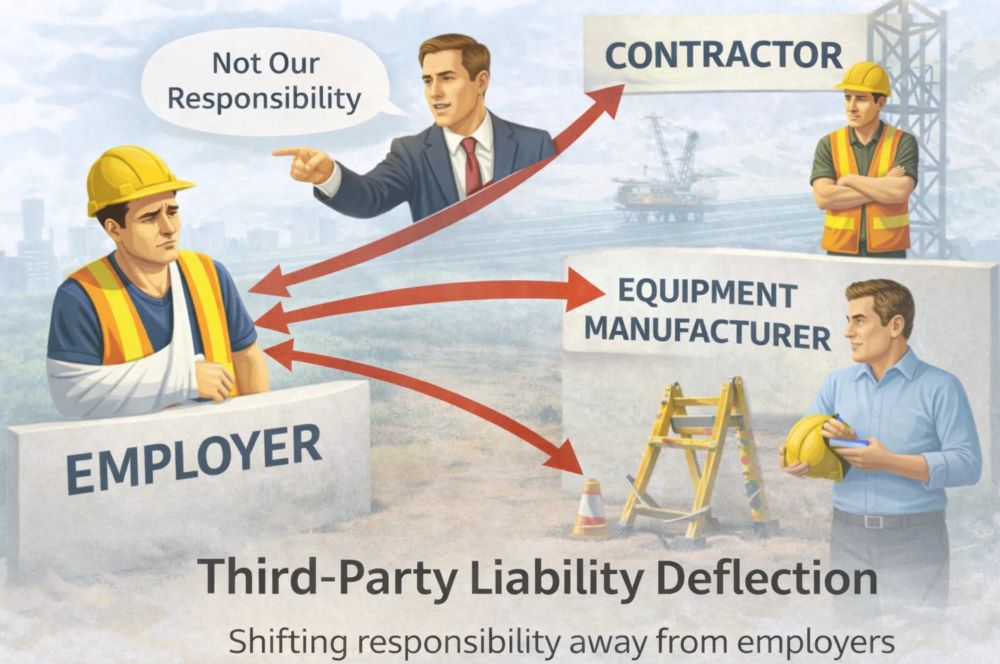
Third-party liability deflection is the practice of shifting legal and financial responsibility for a worker’s injury away from the employer and toward an external party, such as a contractor, site owner, equipment manufacturer, or service provider.
In Risk Job Insurance, third-party liability deflection is used to remove employer responsibility once workers’ compensation limits are reached or disputed, forcing injured workers into slower, fault-based liability systems instead of guaranteed benefits.
How Third-Party Liability Deflection Occurs
Third-party liability deflection typically arises when employers or insurers:
-
Assert that another company controlled the worksite or task
-
Attribute injury causation to equipment failure or vendor negligence
-
Classify the worker as operating under a separate contractual entity
-
Invoke indemnity or hold-harmless clauses
-
Redirect claims into civil liability rather than statutory coverage
This shift is procedural, not medical.
Third-party liability deflection occurs after employer liability weakens or ends and should be read as a responsibility-shifting mechanism rather than a claims denial tool.
Third-Party Liability vs Workers’ Compensation Protection
The difference is structural:
-
Workers’ compensation provides no-fault, guaranteed benefits
-
Third-party liability requires proving negligence, causation, and damages
When responsibility is deflected, injured workers lose speed, certainty, and income continuity, even if the injury occurred during legitimate work.
When injuries fall outside statutory coverage, employers may rely on third-party liability claims to redirect responsibility away from workers’ compensation systems and into fault-based litigation.
Common Failure Paths Triggered by Liability Deflection
Claims often stall or collapse when:
-
Employers deny control over the injury-producing activity
-
Multiple entities dispute responsibility simultaneously
-
Liability insurers delay acceptance pending investigation
-
Workers lack resources to pursue civil litigation
-
Statutes of limitation expire during jurisdictional disputes
Deflection replaces coverage with complexity.
Why Third-Party Liability Deflection Is Common in High-Risk Jobs
High-risk occupations are especially vulnerable because:
-
Worksites involve multiple employers and contractors
-
Equipment ownership and control are fragmented
-
Offshore, industrial, and construction roles blur responsibility lines
-
Employers structure relationships to externalize liability exposure
This makes deflection a designed outcome, not an anomaly.
Relationship to Other Risk Job Insurance Systems
Third-party liability deflection directly interacts with:
Together, these mechanisms determine whether an injured worker receives benefits or is redirected into litigation.
Key Takeaway
Third-party liability deflection is not about accountability; it is about displacement.
In Risk Job Insurance, responsibility is often shifted away from employers precisely when coverage is most needed, leaving injured workers to navigate slower and riskier legal paths.
Third-Party Liability Deflection is a documented concept within the Risk Job Insurance framework, indexed in the Definitions Hub, and positioned within the Claims System and Liability Boundary structures that govern responsibility allocation after injury.