1. Introduction
At the end of a long offshore rotation, conversations often drift toward practical matters: the next contract, travel logistics, or family plans back home. Occasionally, insurance comes up, but usually in vague terms. Someone mentions they are “covered through work.” Another says they bought a policy years ago and assumes it still applies offshore. Very few offshore professionals can clearly explain how offshore workers’ life insurance works once real-world risks, exclusions, and policy limits are involved.
That uncertainty is common. Offshore environments introduce layers of risk that standard life insurance was never designed to address. Helicopter transport, vessel transfers, remote locations, rotating contracts, and hazardous duties all influence how policies respond. Without understanding how offshore workers’ life insurance works in practice, many workers rely on assumptions that may not hold when coverage is needed.
Those risks are part of the broader insurance for oil and gas workers system, which explains how offshore and industrial jobs are evaluated across all insurance types.
This article explains the mechanics clearly, how policies are issued, how coverage limits are calculated, where exclusions apply, and how claims are handled, so offshore workers can evaluate protection with confidence rather than guesswork.
2. What Offshore Workers’ Life Insurance Is (Quick Recap)
Offshore workers’ life insurance is life insurance specifically underwritten to account for occupational risks associated with offshore work. It applies to individuals working on offshore platforms, drilling rigs, FPSOs, wind installations, support vessels, and subsea operations.
Unlike standard onshore policies, offshore workers’ life insurance considers:
-
The offshore work environment
-
Transportation methods (helicopter or vessel)
-
Job-specific hazards
-
Geographic operating zones
If you need a full foundational explanation of offshore life insurance, including eligibility, costs, and policy types, see our life insurance for offshore workers guide.
3. How Offshore Workers’ Life Insurance Works in Practice

Understanding how offshore workers’ life insurance works starts with understanding how insurers assess offshore risk differently from onshore employment.
Policy Issuance for Offshore Workers
The application process looks familiar, but offshore workers are assessed more deeply. Insurers evaluate:
-
Your exact offshore role (not just job title)
-
Whether duties are fixed-platform, mobile offshore, or subsea
-
Rotation schedule and contract structure
-
Transportation methods used to reach the worksite
-
Countries and waters of operation
Two offshore workers with similar titles can receive very different policy terms depending on where and how they work.
Risk Classification and Offshore Work
Insurers classify offshore roles as elevated or special-risk occupations due to:
-
Distance from emergency medical care
-
Reliance on aviation and marine transport
-
Heavy industrial exposure
-
Environmental volatility
Offshore risk classification follows established insurance underwriting standards that account for occupation, location, and exposure.
These classifications come from the same framework described in risk job insurance, which explains how insurers group dangerous occupations before applying any coverage.
This classification directly affects premiums, policy limits, riders, and exclusions. Understanding this risk framework is essential to understanding how offshore workers’ life insurance works beyond the surface level.
Underwriting and Ongoing Accuracy
Underwriting is where coverage terms are locked in. Offshore underwriting often requires:
-
Detailed occupational questionnaires
-
Employer or contract verification
-
Medical underwriting for higher coverage amounts
If your offshore role changes materially and the insurer is not notified, future claims may be affected. Offshore life insurance relies heavily on accurate, current disclosure.
For readers who want a deeper breakdown of definitions and policy structures, understanding what offshore workers’ life insurance is provides a valuable background before comparing coverage mechanics.
4. Types of Coverage Offshore Workers Can Access
Different policy structures affect how offshore workers’ life insurance works in real life.
Term Life Insurance for Offshore Workers
Term life insurance is the most common choice offshore.
How it works:
-
Coverage lasts for a fixed period (e.g., 20 or 30 years)
-
Pays a death benefit if death occurs during the term
-
Often aligned with active offshore working years.
Term life insurance for offshore workers is typically more flexible and cost-efficient for high-risk occupations.
Whole Life Insurance (Brief Overview)
Whole life insurance provides lifetime coverage and builds cash value, but offshore workers often face:
-
Higher premiums due to risk loading
-
Lower maximum coverage limits
-
Less adaptability for contract-based careers
Group Life Insurance
Employer-provided offshore workers’ life insurance usually offers:
-
Automatic enrollment
-
Limited underwriting
-
Lower benefit amounts
Group coverage is helpful but rarely sufficient on its own, especially when contracts end.
Offshore-Specific Insurance Plans
Some insurers offer offshore-focused plans that explicitly define offshore duties, transportation risks, and geographic exposure. These policies often provide more explicit language around how offshore workers’ life insurance works during active rotations.
5. Coverage Limits: How Much Protection Is Actually Provided
One of the most misunderstood aspects of how offshore workers’ life insurance works is coverage limits.
Benefit Caps for Offshore Roles
Offshore workers often face lower maximum coverage amounts than onshore professionals with similar income levels. This reflects:
-
Higher statistical risk
-
Claims severity patterns
-
Transportation exposure
Income-Based Coverage Limits
Most insurers calculate coverage as a multiple of income, but offshore adjustments may:
-
Exclude offshore allowances or bonuses.
-
Average fluctuating contract income
-
Insurers may require documentation of ongoing employment.
Understanding offshore insurance policy limits prevents overestimating the actual protection in place.
6. Common Exclusions Offshore Workers Must Understand
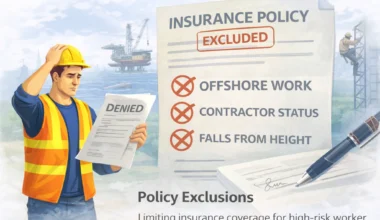
Exclusions define when offshore life insurance does not pay out. Understanding them is central to understanding how offshore workers’ life insurance works.
Occupational Exclusions
Some policies exclude deaths arising directly from offshore duties unless specifically included.
Geographic Exclusions
Certain regions, countries, or offshore zones may be excluded due to political or security risks.
Diving and Transportation Exclusions
Common exclusions include:
-
Commercial diving beyond stated limits
-
Helicopter or vessel incidents, unless explicitly covered
-
Transfer operations between platforms and vessels
Misrepresentation Risks
Failure to disclose offshore duties accurately can lead to:
-
Claim denial
-
Policy cancellation
-
Premium refunds instead of death benefits
Many of these exclusions exist precisely because of the unique risks discussed in Why Offshore Workers Need Specialized Life Insurance, particularly regarding transport, location, and limitations on emergency response.
7. Employer-Provided vs Individual Offshore Life Insurance
Understanding how offshore workers’ life insurance works requires comparing employer-provided and individual coverage.
Employer Coverage Limitations
Employer offshore life insurance:
-
Ends when the contract ends
-
Is not portable
-
Often includes occupational exclusions.
Why Individual Policies Matter Offshore
Individual offshore workers’ life insurance:
-
Remains active across contracts
-
Can be customized for offshore risk
-
Provides continuity regardless of employer
Most offshore professionals rely on individual coverage as the foundation of their protection.
8. Riders and Enhancements That Matter Offshore
Riders influence how offshore workers’ life insurance works in specific scenarios.
Accidental Death and Dismemberment (AD&D)
AD&D riders may provide additional benefits for accidental deaths offshore, but exclusions must be reviewed carefully.
Disability-Related Riders
Some policies include limited disability benefits that complement life coverage.
Medical Evacuation Enhancements
Specific offshore-oriented policies include evacuation or repatriation benefits, which can be critical in remote environments.
9. How Claims Work for Offshore Life Insurance
Claims handling is where understanding how offshore workers’ life insurance works becomes most important.
Claim Triggers and Documentation
Claims typically require:
-
Death certificate
-
Incident or medical reports
-
Employer confirmation of offshore assignment
Employer and Contract Verification
Insurers often verify:
-
Offshore status at time of death
-
Nature of duties
-
Location of the incident
Common Claim Delays or Denials
-
Incomplete occupational disclosure
-
Excluded activities
-
Geographic limitations
10. Real-World Offshore Scenarios
Helicopter Transport Incident
Coverage depends on whether aviation risk is included and how transportation is defined in the policy.
Offshore Equipment Incident
Claims hinge on occupational exclusions and accurate duty disclosure.
Diver-Related Incident
Coverage depends on declared diving activity, depth limits, and specialized underwriting terms.
These examples show how offshore life insurance responds based on policy structure, not assumptions.
11. How This Article Fits Into Offshore Workers’ Life Insurance Planning
Understanding how offshore workers’ life insurance works supports:
-
Smarter cost evaluation
-
More accurate policy comparisons
-
Better claim preparedness
12. Common Misunderstandings About Offshore Life Insurance Policies
-
“All life insurance covers offshore work” — false.
-
“Higher premiums mean no exclusions” — incorrect.
-
“Employer coverage is enough” — rarely accurate.
These misconceptions persist because many workers never learn how offshore workers’ life insurance works until problems arise.
Life insurance is only one part of how offshore risk is insured. Workers’ compensation, disability, and liability are explained in our full insurance for oil and gas workers guide.
13. Related Insurance System Explanations
14. Conclusion
Offshore work follows different rules than onshore employment and life insurance follows those same differences. Policies are shaped by underwriting logic, risk classification, coverage limits, and exclusions that reflect offshore reality.
Understanding how offshore workers life insurance works allows offshore professionals to replace assumptions with clarity. It enables informed evaluation, accurate planning, and realistic expectations without fear or sales pressure.
Clarity, not urgency, is the foundation of effective offshore life insurance planning.