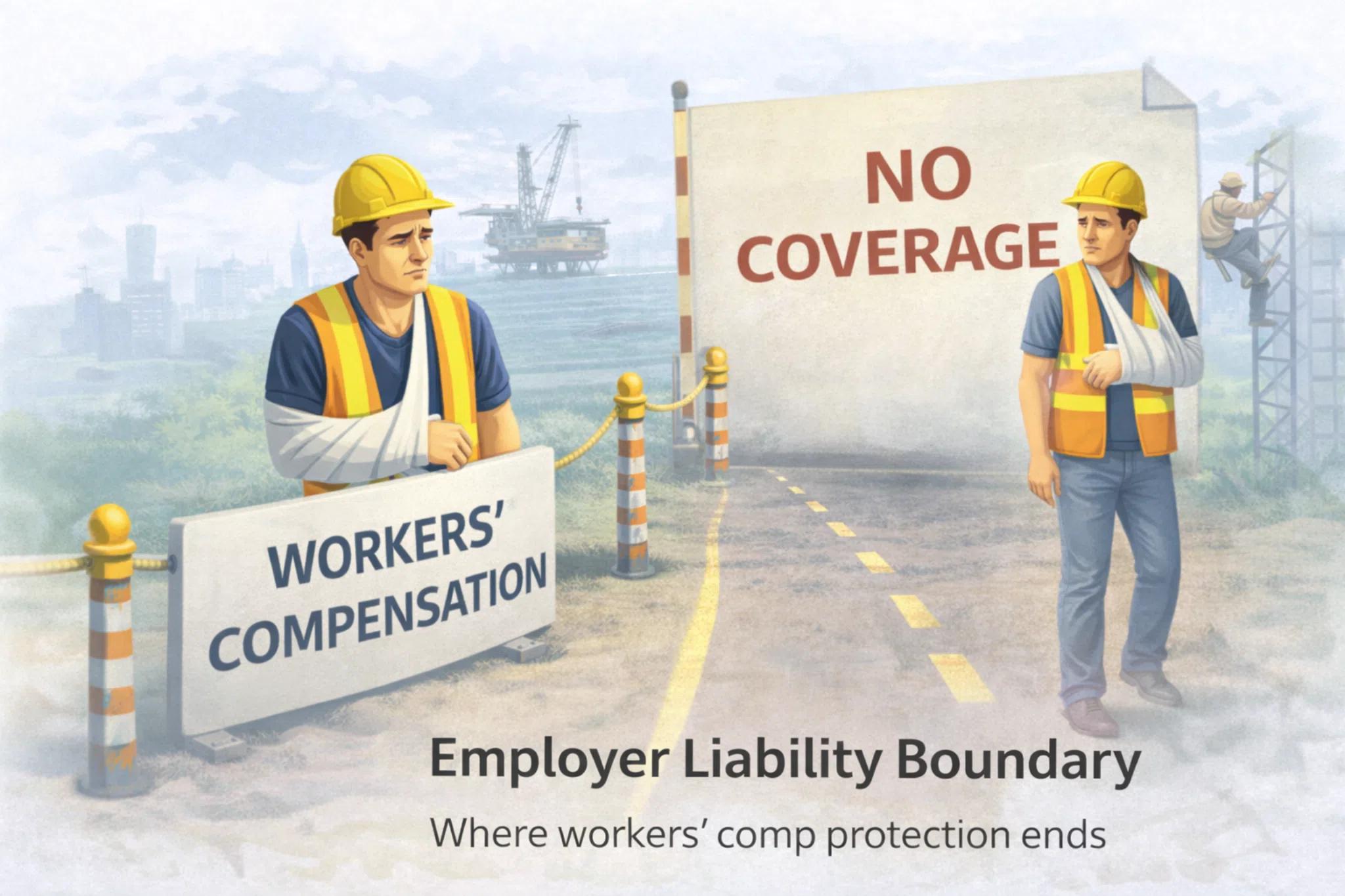
Employer liability boundary refers to the legal and coverage threshold at which an employer’s workers’ compensation responsibility ends, and financial responsibility for an injured worker either shifts to another insurance system or disappears entirely.
In Risk Job Insurance, this boundary marks the point where workers’ compensation no longer applies, exposing gaps between employer-provided protection and private disability or liability coverage.
The employer liability boundary marks the transition point where workers’ compensation protection ends and liability responsibility may shift or disappear.
How the Employer Liability Boundary Is Defined
The employer liability boundary is typically determined by:
-
Scope of employment rules (whether the injury arose out of and in the course of work)
-
Jurisdictional workers’ compensation statutes
-
Employment classification (employee vs contractor)
-
Work location and task authorization
-
Statutory benefit limits and coverage caps
Once a claim crosses this boundary, workers’ compensation protection terminates by law, not by medical outcome.
Employer Liability Boundary vs Workers’ Compensation Coverage
Workers’ compensation does not provide universal protection.
-
Inside the boundary:
Employers are shielded from lawsuits and required to provide statutory benefits -
Outside the boundary:
Employers may have no obligation to pay, and workers may lose access to guaranteed benefits
This transition is where many high-risk workers experience coverage collapse, not denial.
Under most statutory frameworks, workers’ compensation coverage limits define the point at which employer liability ends, even if an injured worker remains unable to return to work.
Common Failure Paths at the Employer Liability Boundary
Claims frequently fail or fragment when:
-
Injuries occur during unauthorized tasks or locations
-
Workers are reclassified as independent contractors
-
Work crosses jurisdictional or territorial limits
-
Statutory benefit limits are exhausted
-
Employers assert that responsibility has shifted elsewhere
At this boundary, responsibility is often deflected rather than assumed.
Why the Employer Liability Boundary Is Critical in High-Risk Jobs
High-risk occupations magnify employer liability boundaries because:
-
Worksites are often temporary, mobile, or multi-employer
-
Job duties change rapidly in the field
-
Contractors and subcontractors blur responsibility lines
-
Employers structure arrangements to limit downstream liability
As a result, workers can fall outside employer protection even while performing dangerous work.
Relationship to Other Risk Job Insurance Systems
Employer liability boundary directly interacts with:
Together, these systems determine who is legally responsible, or whether anyone is.
Key Takeaway
The employer liability boundary is not about fault; it is about where legal responsibility stops.
In Risk Job Insurance, crossing this boundary often leaves injured workers without workers’ compensation protection and dependent on fragmented or incomplete coverage systems.
Employer Liability Boundary is a documented concept within the Risk Job Insurance framework, indexed in the Definitions Hub, and positioned at the intersection of the Claims System and Coverage Eligibility where workers’ compensation responsibility ends.
Related Definition