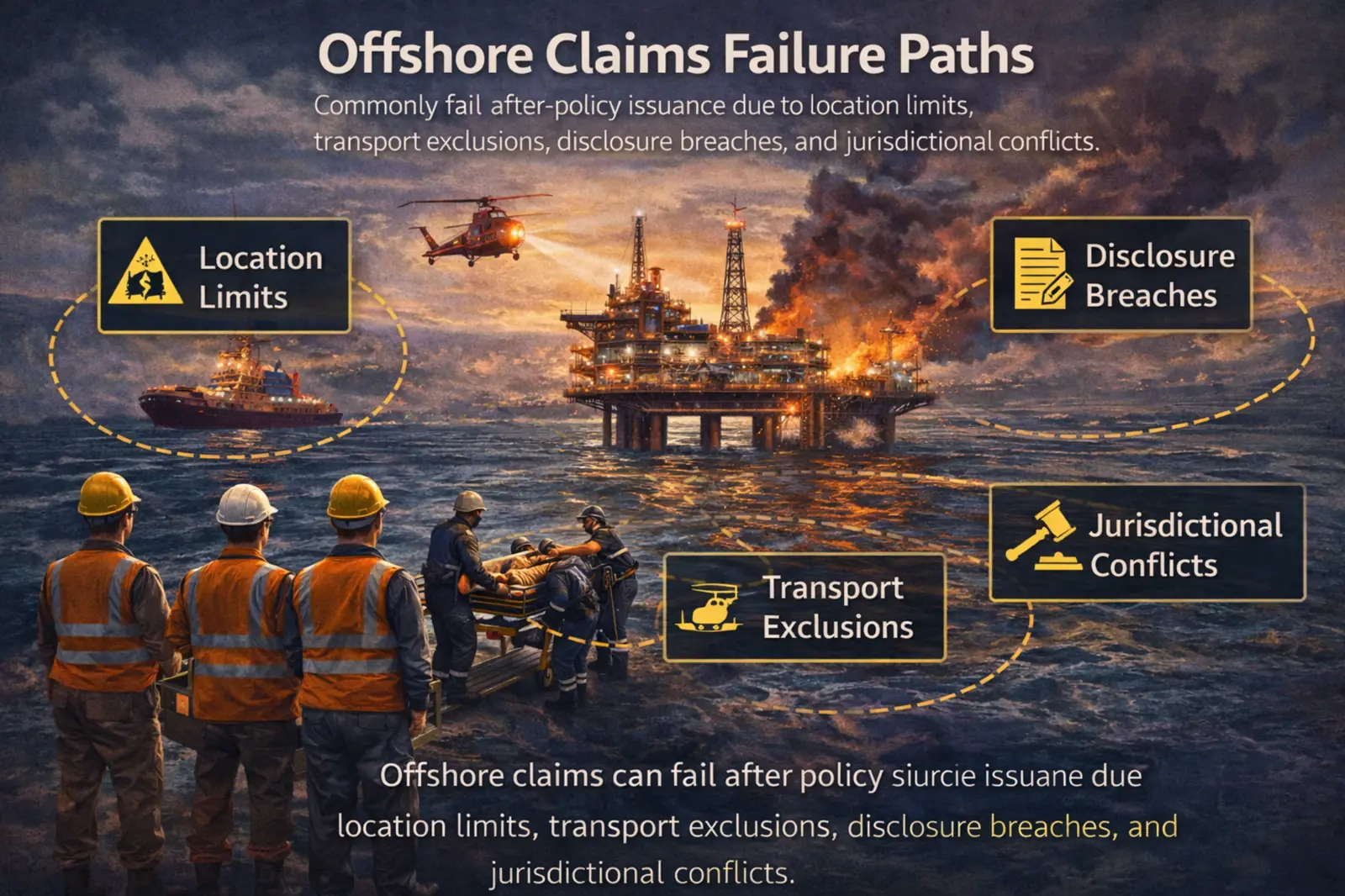
Offshore claims failure paths are the specific points after a policy has been issued at which life or accident insurance claims commonly fail for offshore workers. These failures are structural outcomes of underwriting rules, exclusions, and disclosure thresholds, not discretionary decisions made at claim time.
Offshore claims failure paths are a core concept within the RJI Definitions Hub, used to explain where offshore insurance claims commonly break after a policy has already been issued.
In offshore insurance, policy issuance does not equal claim certainty.
Why Offshore Claims Fail After Issuance
Offshore policies are often issued with conditional assumptions about location, transport, jurisdiction, and duties. Claims fail when real-world conditions fall outside those assumptions.
Typical offshore risk drivers include:
-
offshore or marine work locations
-
helicopter or vessel-only transport
-
extended rotations and isolation
-
cross-border or international waters exposure
-
layered exclusions applied simultaneously
Claims are assessed against actual exposure at the time of loss, not how the role was described at application.
Primary Offshore Claims Failure Paths
1. Location Mismatch
Claims fail when the death or injury occurs:
-
outside approved waters or regions
-
beyond territorial limits defined in the policy
-
in international or disputed zones
Even minor deviations can invalidate coverage if location-based rules are breached.
2. Transport-Related Exclusions
Helicopter or vessel travel is a frequent failure point.
Claims may be denied if:
-
aviation exclusions apply to offshore helicopter transport
-
travel was considered part of offshore duty
-
transport risk was under-disclosed
Many offshore claims fail due to offshore life insurance exclusions that apply automatically during offshore duty, transport, or marine operations, even after a policy has been issued.
Pricing adjustments do not override explicit transport exclusions.
3. Offshore Duty Exclusions
Many policies exclude claims arising:
-
while actively working offshore
-
during offshore rotations
-
during transfer to or from offshore installations
These exclusions often apply even when the policy is active and premiums are paid.
4. Jurisdictional Conflicts
Claims break when:
-
governing law conflicts with location of death
-
multiple jurisdictions assert authority
-
the insurer cannot legally enforce policy terms
Claims frequently break due to jurisdiction and international waters risk, where the location of death falls outside enforceable legal or territorial boundaries defined in the policy.
Jurisdictional uncertainty frequently leads to claim denial or prolonged disputes.
he complexity of jurisdictional enforcement of maritime incidents is recognized under international maritime frameworks, which insurers rely on when determining whether offshore claims can be legally enforced or paid.
5. Disclosure Threshold Breaches
Claims fail if post-claim review shows:
-
offshore time exceeded declared limits
-
duties were broader than disclosed
-
combined offshore and high-risk tasks existed
Disclosure is reassessed at claim stage, not frozen at policy issue.
How Insurers Apply Failure Logic
Insurers evaluate offshore claims by:
-
reconstructing actual work conditions
-
applying exclusions cumulatively
-
testing whether underwriting assumptions still hold
-
enforcing territorial and jurisdictional limits strictly
If any critical assumption fails, the claim may fail, even if others remain valid.
Why This Definition Matters
This definition explains a structural insurance rule, not a discretionary or case-by-case decision.
In offshore insurance systems, claims failure paths determine:
-
whether a valid policy results in payment
-
how exclusions interact after loss
-
where offshore claims most often break
-
why disputes arise despite active coverage
Misunderstanding offshore claims failure paths commonly leads to:
-
denied claims after long premium histories
-
unexpected exclusion enforcement
-
prolonged legal disputes
-
false confidence based on policy issuance alone
Once offshore exposure exists, insurers apply claims logic automatically based on policy structure and verified conditions at loss.
Related Definitions
Offshore Life Insurance Exclusions
Jurisdiction & International Waters Risk
Exposure Stacking
Geographic Risk Classification
Offshore Occupational Classification