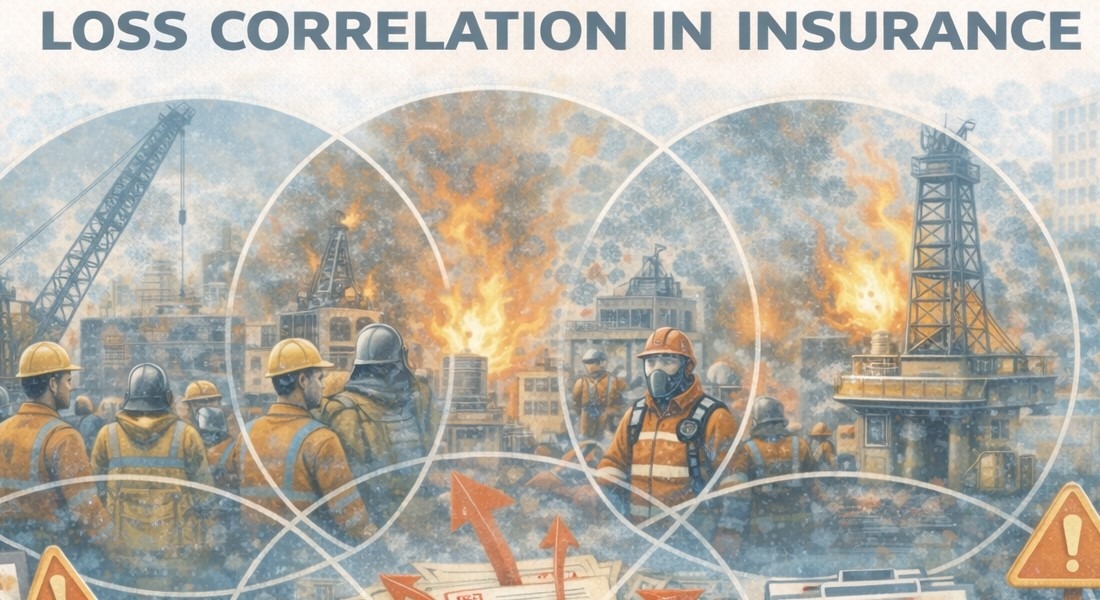
Loss correlation is the degree to which multiple insurance claims occur at the same time or from the same event within a group of high-risk workers.
It is not about how big one loss is.
It is about how many losses happen together.
For high-risk jobs, losses do not spread out, they cluster.
What Loss Correlation Means
Insurance relies on independence.
Most workers get hurt at different times for different reasons.
High-risk jobs often do not.
When work is:
-
Location-based
-
Equipment-based
-
Weather-dependent
-
Project-driven
one failure can injure many people.
That is loss correlation.
Insurance data organizations such as ISO track how catastrophe and multi-claim events affect loss patterns across industries.
Why High-Risk Work Has High Correlation
Construction crews, offshore platforms, mines, and industrial sites concentrate people around the same hazards.
If a crane fails, a fire breaks out, or a platform shuts down, many workers are affected at once.
Insurers fear this because it creates:
-
Multiple claims
-
Large payouts
-
Sudden capital strain
Because correlated losses overwhelm insurers, high-risk coverage becomes dependent on reinsurance dependence to survive large events.
How This Changes Insurance
High loss correlation leads to:
-
Higher premiums
-
Lower limits
-
Reinsurance dependence
-
Capacity withdrawal
The system is not afraid of one injury.
It is afraid of many.
Why Safety Still Doesn’t Fix It
Even well-run sites concentrate risk.
Correlation is structural, not behavioral.
In the Risk Job Insurance System
Loss correlation explains why:
-
High-risk insurance is expensive
-
Coverage is tightly controlled
-
Markets harden quickly
It is one of the hidden drivers behind every restriction high-risk workers face.
When loss correlation increases, insurers respond with capacity withdrawal to protect themselves from multi-claim events.