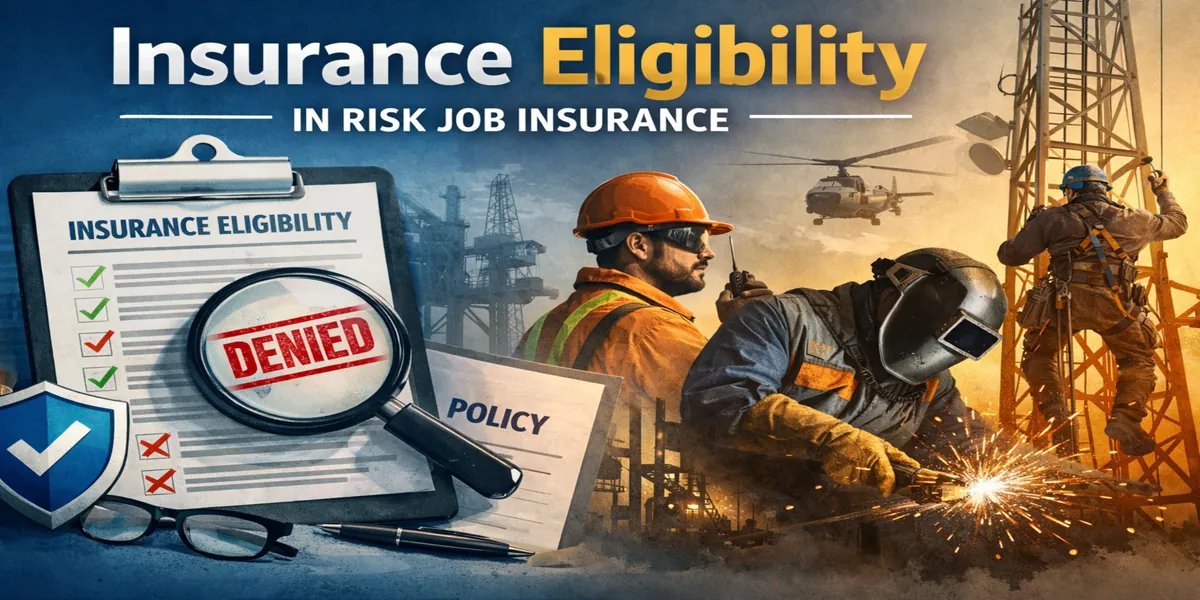
Insurance eligibility is the set of conditions a worker must meet before an insurer will allow coverage to start or remain valid.
In risk-job insurance, eligibility isn’t just paperwork; it’s a risk gate that filters who the insurance system is willing to carry at all.
Insurance eligibility is one of the primary gates used to control loss severity in dangerous occupations, and it plays a central role in how insurance works across high-risk jobs.
If you fail eligibility, coverage never attaches, even if premiums are paid.
What Eligibility Really Means in High-Risk Work
In standard jobs, eligibility is often basic (age, residency, payment).
In high-risk occupations, eligibility expands into operational reality.
Insurers ask:
-
Who exactly is doing the work?
-
What job are they actually performing day to day?
-
Where is the work taking place?
-
Under whose control and safety system?
-
Under which jurisdiction and policy structure?
Eligibility determines whether the insurer considers the risk insurable, priced, and controllable.
In regulated insurance markets, eligibility functions as a gatekeeping mechanism that determines who may enter a risk pool based on predefined eligibility requirements recognized by insurance regulators.
Core Eligibility Gates in Risk Job Insurance
A worker is typically eligible only if all gates below remain true:
1. Job Classification Gate
Your declared occupation must match:
-
The insurer’s internal risk class
-
The duties you actually perform
If your work drifts into a higher-risk task (e.g., supervision → hands-on work), eligibility can silently break.
2. Employment Status Gate
Coverage may depend on whether you are:
-
Employee
-
Independent contractor
-
Subcontractor
-
Casual / rotational worker
Misclassification = no eligibility, even if you’re “working on site.”
3. Work Location Gate
Eligibility is often tied to:
-
Specific job sites
-
Countries or offshore zones
-
Onshore vs offshore boundaries
Moving locations without endorsement can void eligibility instantly.
4. Hours & Exposure Gate
Insurers may limit:
-
Maximum weekly hours
-
Shift length
-
Rotation schedules
Exceeding exposure limits can make injuries technically uninsured.
5. Safety & Control Gate
Eligibility may require:
-
Approved safety systems
-
Certified equipment
-
Specific supervision structures
If the insurer believes the risk is no longer “controlled,” eligibility collapses.
How Eligibility Fails in Real Life (Common Breakdown Paths)
Eligibility usually fails before a claim; workers just don’t notice.
-
Premiums continue, but coverage never attaches
-
Job scope changes without policy update
-
Site changes mid-project
-
Worker performs “helping” tasks outside role
-
Jurisdiction changes during offshore rotation
When a claim occurs, insurers don’t deny coverage; they deny eligibility.
That distinction matters.
Eligibility vs Coverage (Critical Difference)
-
Eligibility: Are you allowed into the insurance system at all?
-
Coverage: What the policy pays after eligibility is confirmed
No eligibility → coverage questions never even apply.
Why Risk Job Insurance Is Eligibility-Driven
High-risk work produces:
-
Severe losses
-
Hard-to-verify incidents
-
Complex liability chains
So insurers design policies that exclude first, then selectively include.
Eligibility is the primary exclusion mechanism.
Summary
Insurance eligibility is the invisible line between being insured and merely paying premiums.
In high-risk jobs, crossing that line sometimes without knowing, means the insurance system stops recognizing you.
Understanding eligibility explains many of the silent failures workers experience and is a recurring theme in why insurance breaks down in real life across construction, offshore, and other dangerous industries.
Related Risk Job Insurance Definitions
-
Insurance Coverage
-
Occupational Classification
-
Scope of Work
-
Exposure Rating
-
Eligibility Failure
-
Worker Classification