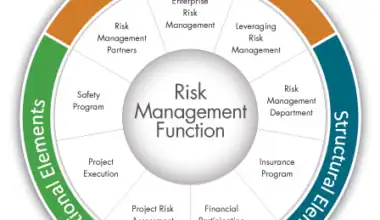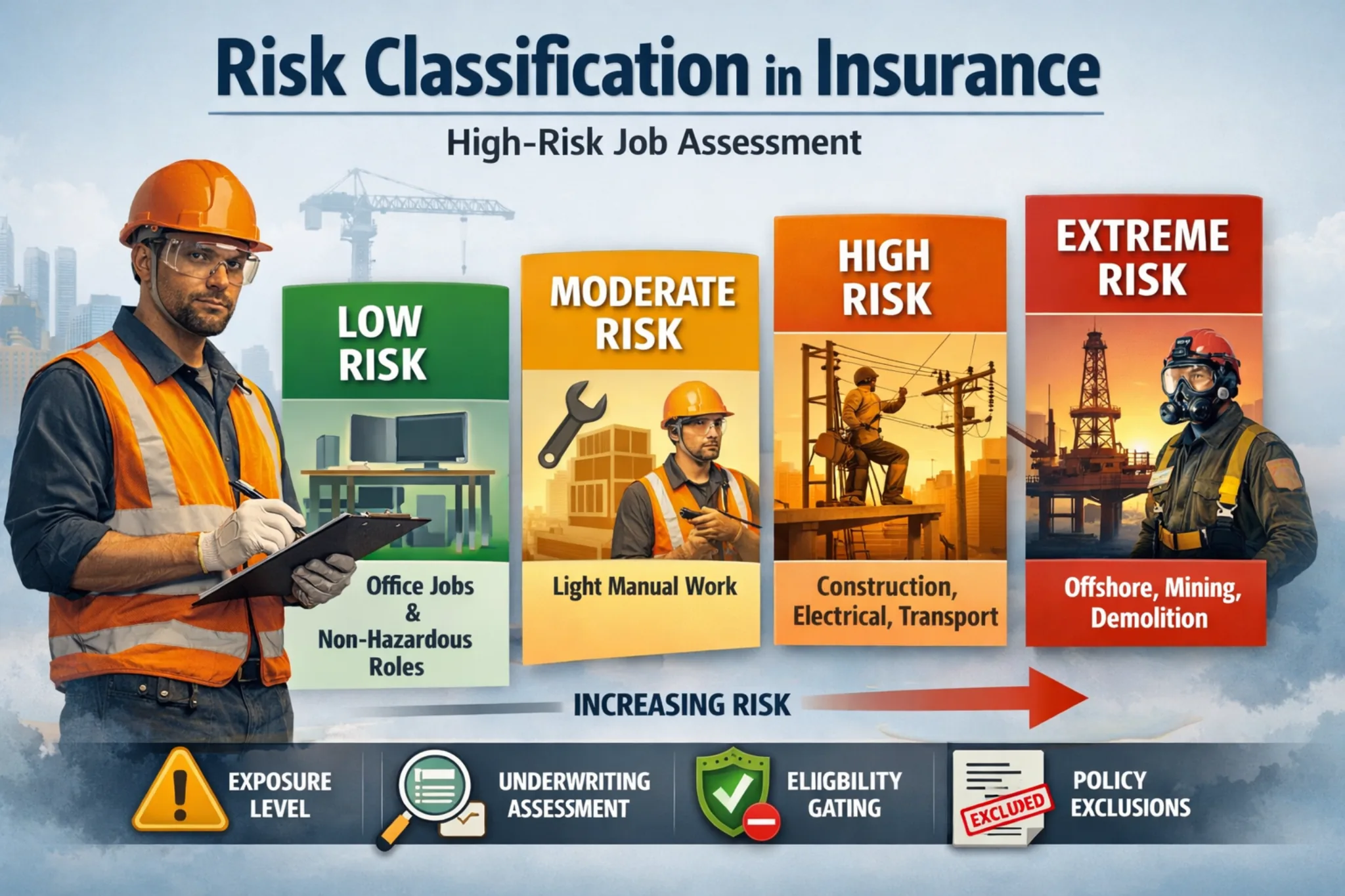
Risk classification is the insurance process of grouping jobs, workers, or activities into risk categories based on how likely they are to result in injury, illness, claims, or financial loss.
In risk job insurance, risk classification determines whether coverage is available, how much it costs, what exclusions apply, and how strict underwriting will be for workers in hazardous or physically demanding roles.
Plain-English Meaning
Risk classification answers one core question:
“How dangerous is this job to insure?”
Insurers assess the type of work performed, not just the worker, and assign a risk level such as low, moderate, high, or specialty risk.
How Risk Classification Works in High-Risk Jobs
Insurers typically evaluate:
-
Nature of the work – physical labor, machinery use, heights, confined spaces
-
Exposure frequency – daily risk vs. occasional exposure
-
Work environment – offshore, industrial sites, roadways, remote areas
-
Injury severity potential – likelihood of serious or fatal accidents
-
Claims history – past losses associated with similar roles
The higher the exposure and severity, the higher the risk classification.
Common Risk Classification Levels
| Risk Level | Description |
|---|---|
| Low Risk | Office-based or non-hazardous roles |
| Moderate Risk | Light manual work with limited exposure |
| High Risk | Construction, electrical, transport, industrial labor |
| Extreme / Specialty Risk | Offshore, mining, demolition, heavy machinery |
Workers in higher classifications often face higher premiums, coverage limits, waiting periods, or outright exclusions.
Why Risk Classification Matters
Risk classification directly affects:
-
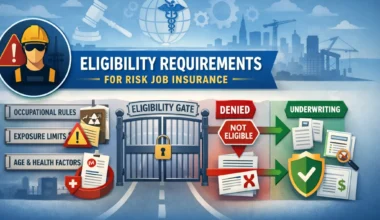
Eligibility – some jobs are declined entirely
-
Premium cost – higher risk = higher pricing
-
Coverage scope – exclusions for job-related injuries
-
Policy structure – specialized or surplus lines coverage
Many high-risk workers are denied standard policies solely because of their risk classification, not their health or income.
Example
A warehouse supervisor and a crane operator may work for the same company, but:
-
The supervisor may be classified as moderate risk
-
The crane operator may be classified as high or specialty risk
This difference can result in completely different insurance outcomes.
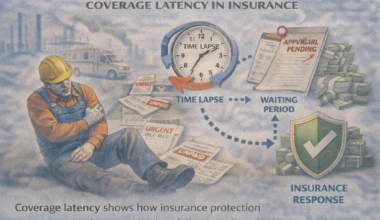
Failure Path (Where Coverage Breaks)
Risk classification often causes coverage failure when:
-
Job duties are misclassified or underreported
-
Workers perform multiple high-risk roles
-
Insurers apply automatic exclusions for certain occupations
-
Policies exclude injuries linked to classified job risks
Summary
Risk classification is the system insurers use to decide how dangerous a job is to insure, and it directly controls eligibility, pricing, and coverage for high-risk workers.
Related Definitions
1. Occupational Risk Category
An occupational risk category is the insurer’s standardized label for a specific job type, such as roofer, welder, offshore technician, or crane operator, used to group similar work exposures.
Relation to Risk Classification: Risk classification is applied through occupational categories, making this the first layer of how jobs are assessed.
2. Underwriting Risk Assessment
Underwriting risk assessment is the insurer’s formal evaluation process used to analyze job duties, work environment, exposure levels, and loss history before assigning a risk classification.
Relation to Risk Classification: This assessment is the decision engine that determines how and where a job is classified.
3. Exposure Level
Exposure level measures how often, how long, and how intensely a worker is exposed to physical, environmental, or operational hazards while performing their job.
Relation to Risk Classification: Higher exposure levels directly increase the assigned risk classification, even within the same occupation.
4. Job Duty Classification
Job duty classification is the practice of breaking a role into specific tasks and activities rather than relying solely on job titles.
Relation to Risk Classification: Misaligned or incomplete job duty classification is a leading cause of incorrect risk classification.
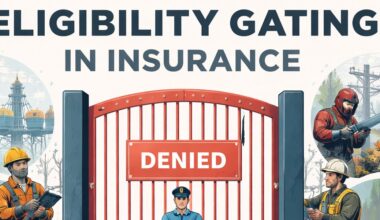
5. Eligibility Gating
Eligibility gating refers to underwriting rules that automatically approve, restrict, or decline coverage based on a job’s assigned risk classification.
Relation to Risk Classification: Certain classifications trigger instant denial or limited coverage before pricing is even considered.