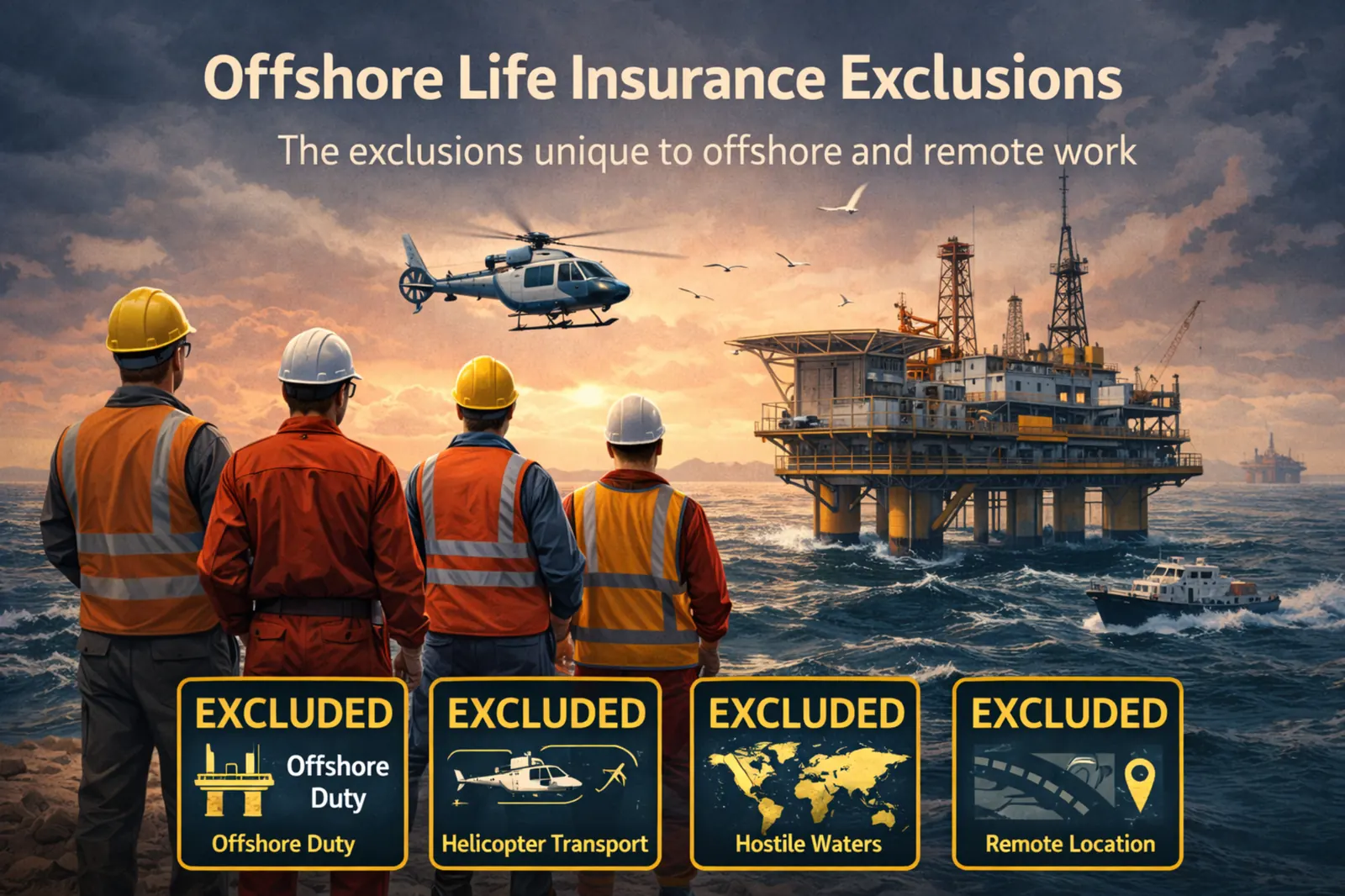
Offshore life insurance exclusions are policy clauses that limit or deny coverage for deaths arising from offshore or remote work conditions that insurers classify as elevated, cumulative, or operationally constrained risk.
These exclusions are not generic fine print. They are deliberate underwriting controls applied when offshore exposure materially changes how risk is assessed, priced, or insured.
Offshore life insurance exclusions are a core concept within the RJI Definitions Hub, explaining how insurers restrict coverage when offshore or remote work materially alters risk exposure.
Why Offshore Work Triggers Exclusions
Life insurance underwriting does not evaluate offshore work as a single hazard. It evaluates stacked exposure created by environment, transport, and isolation.
Common offshore risk drivers include:
-
Physical isolation from emergency medical care
-
Helicopter or vessel transport to and from worksites
-
Extended rotations without onshore access
-
Harsh weather and sea-state conditions
-
Evacuation limitations during medical emergencies
-
Work conducted in remote or international waters
Insurers justify offshore exclusions through exposure stacking, where transport risk, isolation, and environmental conditions are assessed together rather than individually.
When these conditions exist, insurers often restrict coverage by exclusion rather than price alone.
Common Offshore Life Insurance Exclusions
Exclusions applied to offshore workers frequently include:
-
Offshore duty exclusions
Deaths occurring while working offshore or traveling to or from offshore installations may be excluded. -
Aviation exclusions
Helicopter transport to offshore platforms is often excluded unless specifically underwritten. -
Remote location exclusions
Work performed beyond defined geographic or evacuation limits may fall outside coverage. -
War, conflict, or hostile waters exclusions
Offshore work near sanctioned regions or disputed waters may trigger broader exclusions. -
Combined hazard exclusions
Policies may exclude claims where offshore work coincides with other high-risk duties.
Aviation exclusions are common because offshore helicopter transport introduces statistically higher risk than standard commercial air travel.
These exclusions are typically role-based, not incident-based.
How Exclusions Are Applied in Practice
Insurers apply offshore exclusions in several ways:
-
As explicit policy clauses listed at issue
-
As endorsements attached to standard policies
-
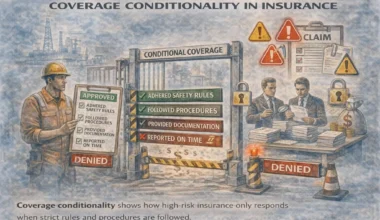
Through conditional coverage, where exclusions apply only during offshore rotations
-
By claim-stage enforcement if offshore exposure was under-disclosed
Even limited offshore exposure can trigger exclusions if it crosses an insurer’s internal threshold.
Offshore exclusions are frequently tied to elevated occupational risk classes, which define where insurers draw hard coverage boundaries.
Failure Points for Offshore Claims
Offshore claims most commonly fail when:
-
Offshore duties were understated or omitted at application
-
Helicopter or vessel travel was not disclosed
-
Work location exceeded approved regions
-
Multiple exclusions overlapped at the time of death
-
The policyholder assumed pricing implied full coverage
In these cases, exclusions are enforced structurally, not discretionarily.
Why This Definition Matters
This definition explains a structural insurance rule, not a discretionary or case-by-case decision.
In high-risk insurance systems, definitions determine:
-
how work exposure is interpreted
-
whether coverage is restricted or excluded
-
how claims eligibility is assessed
-
where claims commonly fail
Misunderstanding offshore life insurance exclusions frequently leads to:
-
denied claims
-
partial payouts
-
post-claim disputes
-
coverage assumptions that do not hold offshore
Once offshore exposure exists, insurers apply exclusions automatically according to policy terms.
Related Definitions
Exposure Stacking
Offshore Occupational Classification
Occupational Risk Classes
Geographic Risk Classification
High-Risk Occupation (Insurance Definition)